
APQP (Advanced Product Quality Planning)
PPAP (Production Part Approval Process)
Quality Core Tools
At NXLP, we design and implement APQP systems tailored to your sector, your customers, and your internal capability.
Whether you're working to:
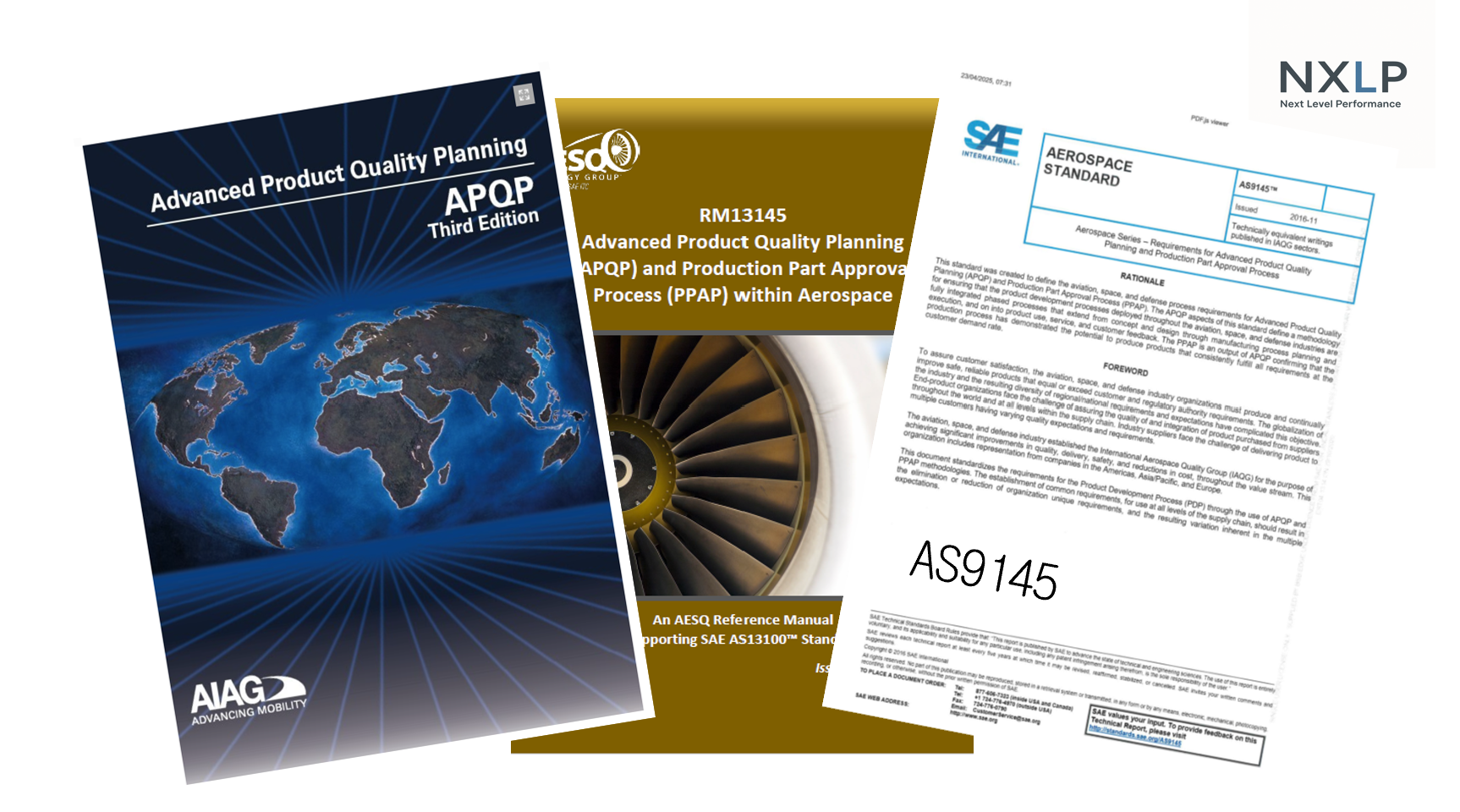
(AIAG) Automotive Industry Action Group APQP (Automotive)
AS9145 (Aerospace APQP)
RM13145 (AESQ) Aero Engine Supplier Quality
We build an APQP framework that fits your business, not someone else’s template.
APQP Training
For businesses that want capability.
What you get:
Sector-specific APQP training (AIAG, AS9145 or RM13145)
Clear phase & gate structure
Core tools integration
Practical execution guidance
Real-world examples, not theory
Introduction to Core Tools (FMEA, MSA, Control Plan & SPC)
Your team understands what good looks like — and how to run it.
Training + Implementation
For businesses that want structure and accountability.
What we do:
Deliver training
Design your tailored APQP framework
Build your gate review structure
Align with your QMS (AS9100 / IATF / ISO)
Define ownership & governance
Support live programme rollout
Training on Core Tools (FMEA, MSA, Control Plan & SPC)
You don’t just understand APQP.
You embed it.
Quality On Demand
(We Do It For You)
For businesses that need immediate control.
We become your APQP engine.
We:
Lead APQP on live programmes
Run gate reviews
Manage risk tracking
Oversee FMEAs and control plans
Support PPAP submission
Strengthen supplier APQP
Interface with customers
You get predictable launches without hiring a full-time senior resource.
Flexible. Scalable. Controlled.
Typical Course Content -
Can also be tailored depending on skills and experience.
1. Introduction to APQP and PPAP
Understanding APQP: Overview of the Advanced Product Quality Planning framework and its role in managing product development and quality planning.
What is PPAP?: Comprehensive look at the Production Part Approval Process, how it fits into the product lifecycle, and why it’s critical for customer approval.
2. APQP: Five Phases of Quality Planning
Phase 1: Planning & Defining the Program
Aligning customer requirements with internal processes.
Defining project objectives, timelines, and goals.
Phase 2: Product Design and Development
Conducting Design Failure Mode and Effect Analysis (DFMEA).
Design validation, reviews, and prototype testing.
Phase 3: Process Design and Development
Process flowcharts, Process Failure Mode and Effect Analysis (PFMEA), and Control Plans.
Phase 4: Product and Process Validation
Pre-production trial runs and validation.
Measurement System Analysis (MSA) and Statistical Process Control (SPC) studies.
Phase 5: Continuous Feedback & Corrective Actions
Implementing continuous feedback loops.
Addressing corrective actions to improve future production runs.
3. PPAP: Ensuring Production Readiness
The Key Elements of PPAP: In-depth coverage of each element, including design records, process flows, control plans, and process capability studies.
Preparing PPAP Documentation: How to create, submit, and manage the Part Submission Warrant (PSW) and supporting documents for customer approval.
4. Key Tools and Techniques
Risk Management Tools: Using DFMEA and PFMEA to identify and mitigate risks early in the design and production processes.
Statistical Analysis: Conducting Measurement System Analysis (MSA) and Statistical Process Control (SPC) to ensure process capability and quality.
Control Plans: Developing and maintaining control plans to ensure consistent, repeatable production quality.
5. Deployment & Integration into Organizational Culture
Sustainable Implementation: Strategies to embed APQP and PPAP into the organizational culture, ensuring they become part of everyday operations.
Cross-Functional Teams: Training on how to build and manage cross-functional teams to improve communication and collaboration between departments.
Leadership and Continuous Improvement: How leaders can drive continuous improvement efforts and foster a culture that supports APQP and PPAP practices.
6. Real-World Applications
Case Studies: Real-life examples of successful APQP and PPAP implementations in various industries.
Hands-On Exercises: Practical workshops that simulate real-world scenarios, allowing participants to practice creating control plans, conducting PFMEA, and preparing PPAP documentation.
7. Sustaining Results
Best Practices: Insights on how to sustain the benefits of APQP and PPAP through ongoing audits, performance reviews, and continuous improvement initiatives.
Training Outcomes
Participants will leave the training with:
A comprehensive understanding of APQP and PPAP processes.
The ability to develop and implement control plans, DFMEA/PFMEA, and process validation methods.
Skills to integrate these quality planning processes into their organizational culture to ensure long-term success.
Practical experience preparing PPAP submissions and engaging with customers during the approval process.